

1Introduction
The “gabarre” (a flat-bottomed boat used to transport goods along the river) tour heads to the Vienne district on the other side of the Loire.
Circuit lenght 2,7 km
2Quai de la Saussaye
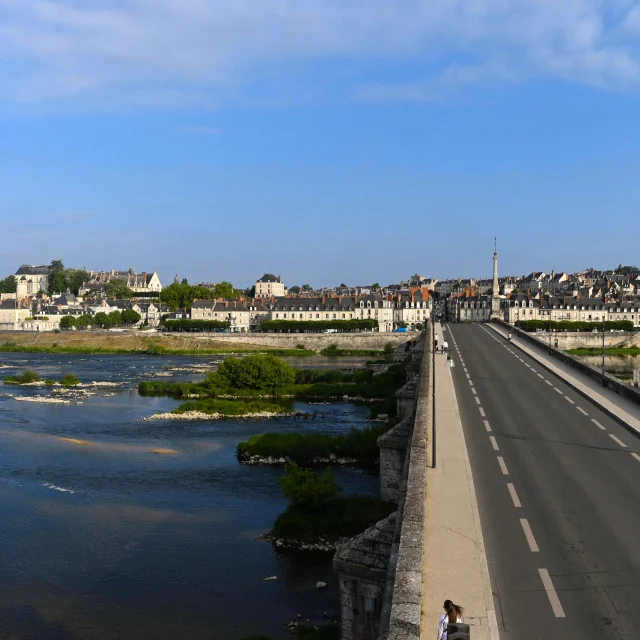
Head down Rue du Commerce as far as the river. Formerly known as Grand Rue, it once led directly to the town’s medieval bridge. Below the quay, the base of the pillars of this bridge, destroyed by flooding in 1716, are visible amid the eddies of the Loire. The bridge was subsequently replaced by the Pont Jacques Gabriel 80m upstream.
3
4Quai Villebois Mareuil
Cross the Pont Jacques Gabriel to reach the Quai Villebois Mareuil, then follow Rue du Moulin-à-Battoir to get to the old quarters of Vienne, protected from river floods by a dyke.
5
6Rue du Poinçon Renversé
Rue du Poinçon Renversé takes its name from a hotel that bore this name. A “poinçon” is a 228-litre barrel which acted as a unit of measurement for wine. The name may date back to the time when the Vienne quarter was the district inhabited by barrel-makers.
7Angle rues Poinçon-Renversé et Munier
At the end of the street, note the ex-voto dedicated to Our Lady, placed here in 1849 to give thanks to the Virgin for having ended a cholera epidemic.
8Aître St Saturnin
In Rue Munier, a large carriage entrance to the right marks the entrance to the Saint-Saturnin charnel house, a former cemetery built with timber galleries in 1515, during the reign of François I.
9Inside aître St Saturnin
Used until the 19C to bury parishioners, it is now home to the town’s lapidary collection (open during National Heritage days or by prior arrangement – contact the Château de Blois for more information).


10Churche St Saturnin
Enter Saint-Saturnin church via the side door. The church was once an important place of pilgrimage in honour of Notre Dame des Aydes. Its walls are covered with ex-votos, inscriptions and pictures given in thanks to prayers answered by the Virgin. The large window in the chapel to the left of the choir was offered by the parishioners of Vienne as thanks for her protection during the major flood of 1866. It depicts the inhabitants of the Vienne district crossing the bridge to take refuge in the centre of Blois.
11
12Rue de la Chaîne
Rue de la Chaîne probably takes its name from the iron chains stretched across the road during troubled times and at night – unlike the town, the Vienne district was not fortified. This street has preserved many houses from the Middle Ages, with their arched doorways and half-timbered façades, occasionally masked by render.
1329 rue de la Chaîne
At n° 29, a mark on the wall indicates the level of the flood of 1846, which was one of the highest ever recorded in Blois, along with that of 1856, ten years later.
14Port de la Creusille
During the 19C, the Port de la Creusille was reserved for heavy, cumbersome materials such as stone and wood. It was also used to unload sand extracted from the Loire and intended for use on construction sites. However, the majority of river traffic, such as wine, wheat and salt, was handled on the opposite bank of the river. In the 19C, the invention of a forerunner of the steam engine by an engineer from Blois, Denis Papin (1647-1712), was to revolutionise the life of the river. Boats known as “inexplosibles” sailed up and down the Loire until the arrival of the railway line, which gradually led to the decline of river traffic. For many years, the chocolate manufacturer, Auguste Poulain, used the Loire to transport cocoa beans and his company’s bars of chocolate.
16Orientation table
As you head back towards the bridge, an orientation table provides information on the view of Blois and the river, the latter a listed UNESCO World Heritage Site. To return to the starting point of the walk, cross back over the river and follow the bronze markers in the opposite direction.
17
20